
STRONG TODAY, HOPEFUL FOR TOMORROW
Living with SMA and advocating for progress
From physical therapy (PT) to workarounds to emerging muscle science, this is your guide to strength and independence in SMA.

PHYSICAL THERAPY: USE IT OR LOSE IT
Physical therapy (PT) is a muscle-focused approach to SMA that you probably already know well. It’s one of the main ways people with SMA work to maintain and support muscle strength. Whether you or your loved one walks, uses a wheelchair, or both, PT can help keep muscles active and engaged—and that’s important because muscle use may improve strength, endurance, and all the movements that make up our daily lives.
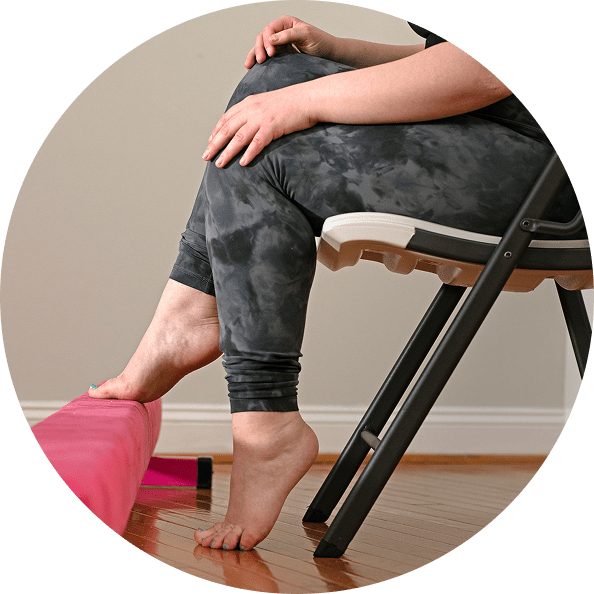
PT often includes gentle exercises, stretching, joint mobilization, and assistive devices. Together, these strategies can help preserve range of motion and promote muscle strength.
Living with SMA and advocating for progress
Speak up about your needs
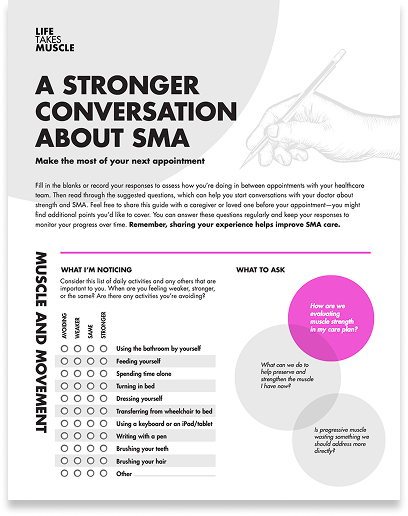
If you’re noticing that your strength or ability to do daily activities is changing, be sure to keep your healthcare team in the loop—especially about the role of progressive muscle wasting in SMA. Taking care of your muscles is something you can do now to help create more possibilities in the future. That’s why muscle health deserves a place in every SMA care plan.
Want help tracking your symptoms? See our Self-Advocacy Guide for tips on how to assess your function and discuss it with your providers.
SEE A PHYSICAL THERAPIST DISCUSS MUSCLE IN SMA
SMART WORKAROUNDS
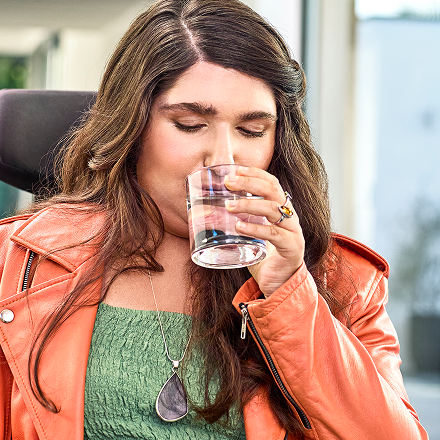
Even with PT, the fatigue in SMA is real. It often feels like your muscles are weakening throughout the day, making moving, chewing, swallowing, or even staying focused seem harder over time. It’s a serious challenge in SMA, but the community has done what it always does: adapted brilliantly. Children and adults living with SMA—and the caregivers right alongside them—continue to invent creative workarounds or hacks to help conserve energy and strength, which in turn can promote independence.


physical
workarounds
Using devices, positioning, gravity, or smaller muscles to help complete a task.
Like using your arms to place your legs in a car.

Living with SMA and advocating for progress

behavioral
workarounds
Planning ahead, pacing yourself, choosing which activities matter most, or redesigning routines in order to combat fatigue.
Like drinking less water before an activity to avoid having to go to the bathroom.
Living with SMA and advocating for progress
Workarounds are a powerful expression of this community’s resilience and a reminder of the challenges that remain.
People with SMA, caregivers, and advocates are asking for more strength and motor function. And the field of muscle research is responding.
GET INSPIRED WITH WORKAROUNDS THAT WORK
MYOSTATIN AND THE FUTURE OF SMA SCIENCE
Balance is a big part of how the body functions. Several of our most critical systems rely on checks and balances—like maintaining a steady temperature and regulating blood pressure. Muscle growth works in the same way. When muscles are used, they increase the production of proteins that enhance muscle growth. But when they’re not used, they decrease protein production, and muscle growth slows.
Meet Myostatin
One key part of the balancing system in muscle is myostatin, a naturally occurring protein that acts as a “brake” to keep muscle growth in check. Everyone has myostatin, mainly in skeletal muscles that enable voluntary movement. Myostatin isn’t the cause of SMA, but scientists are studying what happens when the myostatin “brake” on muscle growth is released, and whether targeting myostatin could help treat progressive muscle wasting.


Could myostatin research lead to new approaches that address the challenges of life with SMA?
This is a current focus of muscle research—building on today’s advances in SMN-targeted treatments while looking toward what may be possible in the future.